


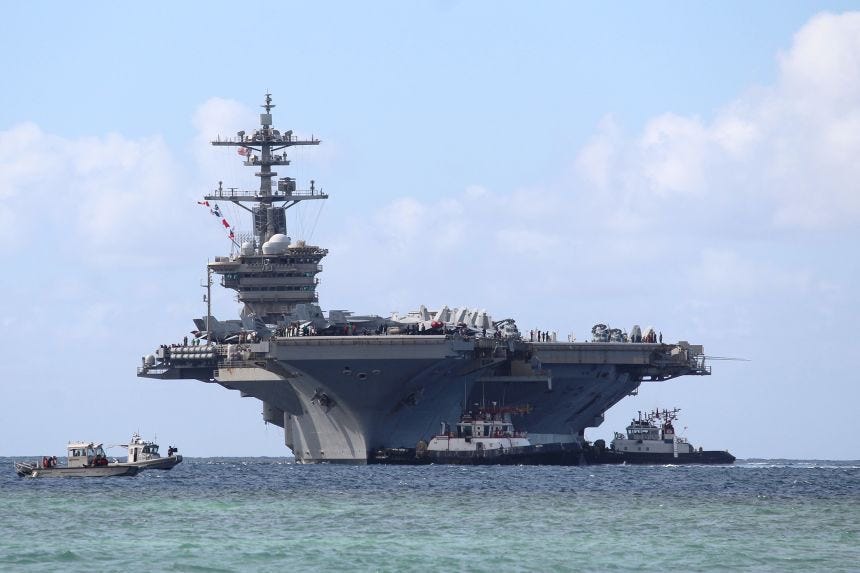
Washington — As concerns grow over conditions aboard the USS Abraham Lincoln, questions are increasingly being directed at Defense Secretary Pete Hegseth, whose Pentagon helped oversee the carrier’s extended combat deployment in the Middle East.
Hegseth is not personally responsible for every maintenance failure, broken fixture, plumbing problem, or day-to-day command decision aboard the nuclear-powered aircraft carrier. But as secretary of defense, he does carry substantial responsibility for the larger military decisions that determine where American forces are sent, how long they remain deployed, and whether the military has enough resources and personnel to sustain those operations safely.
That distinction is critical.
An Aging Carrier Under Heavy Pressure
The USS Abraham Lincoln is a Nimitz-class aircraft carrier commissioned in 1989. Like other aging ships in the U.S. fleet, it operates within a Navy that has faced years of maintenance delays, shipyard backlogs, parts shortages, staffing problems, and extremely demanding operational schedules.
Those problems existed long before Hegseth became defense secretary.
But the Lincoln has since been subjected to an unusually demanding deployment, including extended operations connected to the conflict with Iran.
The longer a carrier remains continuously deployed, the more difficult it becomes to perform certain maintenance, rotate personnel, replenish supplies, give sailors adequate rest, and address problems that would normally be handled during port visits or scheduled maintenance periods.
That is where responsibility begins moving upward.
What Hegseth Actually Controls
A defense secretary does not decide when a toilet gets repaired or which sailor fixes a broken pump.
Hegseth does, however, sit near the top of the decision-making structure responsible for military force posture.
His department helps determine whether a carrier remains in a combat theater, whether another ship is available to relieve it, whether operational demands are sustainable, and whether military commanders have enough resources to support sailors carrying out the mission.
The relevant questions are therefore larger than individual equipment failures.
How long was the Pentagon willing to keep the Lincoln deployed?
Were Navy leaders warning that the ship and its crew were becoming overstretched?
Was another carrier available to relieve it sooner?
Were maintenance, food, water, medical care, spare parts, mail delivery, and mental-health resources keeping pace with operational demands?
Those are leadership questions.
And those questions reach the Office of the Secretary of Defense.
Trump Sets the Political Strategy
Responsibility does not stop with Hegseth.
President Donald Trump is commander in chief and ultimately establishes the administration’s broader military strategy.
If the administration decides that a carrier must remain in a combat zone because of operations involving Iran, the Defense Department must turn that political decision into an executable military strategy.
That means Trump carries responsibility for the larger policy.
Hegseth carries responsibility for how the Pentagon implements it.
Navy leadership carries responsibility for managing the fleet.
Commanders aboard the carrier remain responsible for day-to-day operations.
The controversy therefore cannot reasonably be blamed on one individual.
But neither can senior Pentagon officials separate themselves completely from conditions created by an extended deployment they helped sustain.
The Response May Matter as Much as the Original Problems
Hegseth has faced additional criticism over his public response to reports about deteriorating conditions aboard the carrier.
Rather than simply acknowledging the concerns and explaining what the Pentagon was doing to address them, Hegseth has argued that some reporting about conditions aboard the ship was misrepresented.
That response raises another issue.
Even if some allegations were exaggerated or incomplete, reports involving food, plumbing, supplies, morale, maintenance, family concerns, and sailor welfare deserve investigation rather than dismissal.
The Pentagon has enormous power over the lives of service members.
When sailors are ordered into prolonged combat operations, civilian leaders have an obligation not only to accomplish the mission but also to ensure that the people carrying it out are properly supported.
This Is Bigger Than Broken Toilets
Reducing the controversy to malfunctioning bathrooms or uncomfortable living conditions misses the larger story.
An aircraft carrier is essentially a floating city carrying thousands of people while operating one of the most complicated weapons systems ever built.
When that ship remains deployed for months beyond its normal schedule, even relatively small problems can become serious.
Maintenance gets postponed.
Equipment wears down.
Parts become harder to obtain.
Sailors become exhausted.
Families remain separated.
Morale deteriorates.
And commanders have fewer opportunities to reset the ship.
Those consequences are predictable.
That means senior leadership has to account for them before repeatedly extending deployments.
Where Responsibility Falls
The fairest assessment places responsibility across several levels.
President Trump bears responsibility for the political and military strategy requiring sustained American operations in the region.
Secretary Hegseth bears significant responsibility for Pentagon decisions involving force deployment, readiness, logistics, carrier rotations, and whether military demands exceed what personnel and equipment can reasonably sustain.
Senior Navy leadership bears responsibility for fleet management, maintenance, supply chains, personnel readiness, and communicating when ships are reaching their limits.
The Lincoln’s commanding officers are responsible for problems that can reasonably be corrected aboard the ship.
Congress and previous administrations also share responsibility for long-standing problems involving shipbuilding, maintenance infrastructure, fleet size, procurement, and readiness.
The Real Accountability Question
The strongest criticism of Hegseth is therefore not that he personally caused every problem aboard the USS Abraham Lincoln.
It is that Pentagon leadership helped place an aging carrier and thousands of sailors under extraordinary operational pressure and must answer for whether enough planning was done to support them.
The central question is simple:
If America’s leaders decide to send service members into prolonged combat operations, did those same leaders provide them with the resources, maintenance, relief, and support necessary to safely carry out the mission?
That is the standard by which Hegseth—and the rest of the national-security leadership—should be judged.
The sailors aboard the USS Abraham Lincoln did not choose the geopolitical strategy.
They were ordered to execute it.
Their civilian and military leaders are responsible for making sure they are not forced to pay for strategic decisions with preventable hardship.
If you want news without the spin, propaganda, or political theater, subscribe to The BFM Report on Substack.
We break down what’s happening, who’s responsible, and what it means for everyday Americans.


